

1. What Is White Release Paper?
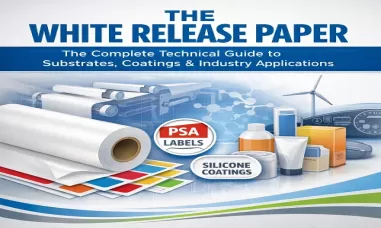
White release paper — also called a release liner or silicone paper — is a multi-layer sheet engineered to protect pressure-sensitive adhesives (PSA) and allow clean, controlled separation at the point of use. The term "white" refers to the most commercially widespread surface color, though liners are also produced in yellow, brown, blue, and transparent variants to support color-coded inventory systems or process identification requirements.
At its most basic, a release liner consists of three functional zones: a base substrate (the structural carrier), an intermediate barrier or PE coating (to control porosity and surface energy), and a silicone release layer (the functional non-stick surface). Understanding each zone is essential for specifying the right product for your process.
2. Substrate Types & Their Properties
The choice of base substrate fundamentally determines the mechanical strength, dimensional stability, moisture resistance, and processing behavior of the finished liner. Wanbaolong's PE Coated Paper & Silicon Paper Series covers the most widely used substrate families:
| Substrate | Basis Weight (g/m²) | Key Properties | Typical Use |
|---|---|---|---|
| Glassine Paper | 60 – 90 | Super-calendered, smooth, semi-transparent, excellent silicone anchorage | Labels, tapes, food packaging |
| Kraft Paper (Brown / White) | 60 – 150 | High tensile strength, fibrous texture, requires PE or clay barrier | Industrial tapes, heavy-duty labels |
| Semi-Gloss Paper | 80 – 120 | Clay-coated, printable surface, balanced stiffness | Premium labels, promotional stickers |
| Anti-Stick Paper | 70 – 110 | Pre-treated surface, consistent release, cost-effective | Self-adhesive labels, general liner |
| CCK (Clay Coated Kraft) | 80 – 140 | Smooth clay face, strong kraft backing, good dimensional stability | Die-cut labels, graphic arts |
| PET Release Film | 23 – 75 µm | Film-based, zero moisture absorption, excellent caliper uniformity | Electronics, medical, optical adhesives |
Table 1 — Common release liner substrate types and their primary characteristics.
3. The Role of PE Coating in Release Liners
Polyethylene (PE) coating is applied between the paper substrate and the silicone layer for two critical reasons. First, it seals the porous fiber network of the paper, preventing silicone from "sinking" into the substrate — a phenomenon that would cause inconsistent release values and silicone waste. Second, PE provides a uniform, chemically inert surface to which the silicone will bond predictably.
PE coatings are applied by extrusion at thicknesses typically ranging from 10 µm to 30 µm. LDPE (Low-Density Polyethylene) remains the most common grade due to its flexibility and adhesion to paper, while HDPE is occasionally used where higher stiffness is required. The PE layer also meaningfully improves the moisture barrier of the liner, which is especially important in humid storage and tropical shipping conditions — a critical consideration for Wanbaolong's global customer network.
One-Side vs. Two-Side PE Coating
Standard release liners use one-side PE coating (PE applied to the face that receives silicone). In certain high-performance applications — particularly where the liner must also serve as a moisture barrier on both surfaces, or where back-side printability on a PE surface is required — two-side PE coating is specified. Two-side coated liners cost approximately 15–25% more but offer superior flatness and reduced curl in humid environments.
4. Silicone Release Coatings: Chemistry & Cure Systems
The silicone layer is the functional heart of the release liner. It creates a low-energy surface that allows adhesives to wet out fully during lamination, yet separate cleanly during dispensing. The chemistry of the silicone system determines release force, anchorage to the substrate, migration resistance, and compatibility with different adhesive chemistries.
| Cure System | Mechanism | Coat Weight (g/m²) | Advantages | Limitations |
|---|---|---|---|---|
| Thermal / Platinum Catalyzed | Hydrosilylation at 100–160 °C | 0.8 – 1.5 | Fast cure, very low silicone coat weight, excellent anchorage | Requires heat; temperature-sensitive substrates need care |
| UV Cationic | Epoxy-silicone opened by photo-acid generator | 1.0 – 2.0 | Low energy, room-temperature cure; suitable for film substrates | Limited cure depth on opaque substrates; higher cost chemistry |
| EB (Electron Beam) | Radical crosslinking by electron bombardment | 1.0 – 1.8 | Solvent-free, high throughput, excellent migration resistance | High capital cost equipment; limited to specialized converters |
| Solventborne (legacy) | Condensation crosslinking + solvent evaporation | 1.5 – 3.0 | Wide chemistry latitude, mature technology | VOC emissions; declining use due to environmental regulations |
Table 2 — Silicone cure systems used in release liner manufacturing.
Modern high-performance liners — including those produced at Wanbaolong's manufacturing base — predominantly use platinum-catalyzed thermal cure systems, which deliver ultra-thin, precisely controlled coat weights and the cleanest possible release surface. This technology is critical for applications requiring zero silicone transfer (e.g., optical films and medical-grade adhesives).
5. Release Force: Specification, Measurement & Selection
Release force (measured in cN/cm or g/cm at a defined peel angle and speed) is perhaps the single most important performance parameter for a release liner. Too low a release force, and the liner may lift prematurely on roll stock or during converting. Too high, and the liner resists peeling and can damage delicate face materials or de-laminate the adhesive from the face stock.
Ultra-Light Release
< 5 cN/cm — used with aggressive hot-melt adhesives; high-speed automated dispensing
Light Release
5 – 15 cN/cm — standard label stocks, general-purpose PSA tapes
Medium Release
15 – 40 cN/cm — transfer tapes, double-sided tape, foam tapes
Tight / Heavy Release
> 40 cN/cm — structural bonding adhesives, architectural glazing films
Release force is tuned primarily through silicone formulation — specifically the ratio of reactive functional groups, the use of controlled-release additives (CRAs), and cure conditions. Wanbaolong's technical team supports customers in defining the correct release window through sample evaluation and application trials. Contact the team via wbl.fred@gmail.com or by phone at +86-19975380486.
6. Key Performance Properties of White Release Paper
| Property | Test Standard | Significance |
|---|---|---|
| Release Force | FINAT FTM 10, PSTC-7 | Defines peel behavior; critical for process compatibility |
| Subsequent Adhesion (SA%) | FINAT FTM 11 | Measures adhesive integrity after liner removal — must remain ≥ 90% |
| Silicone Coat Weight | XRF fluorescence | Uniformity across web width ensures consistent release across a roll |
| Moisture Vapor Transmission Rate (MVTR) | ASTM E96 | Important for humidity-sensitive adhesives and outdoor label durability |
| Caliper / Thickness | TAPPI T411 | Affects die-cutting accuracy and roll geometry in automated dispensing |
| Machine Direction Tensile | TAPPI T494 | Liner must survive web tension in high-speed laminators without breaking |
| Silicone Migration | Ink adhesion test (printability) | Migrated silicone on face stock surface impairs ink and coating adhesion |
| Temperature Resistance | Application-specific | PE-coated liners typically rated to 120 °C; PET film liners up to 180 °C |
Table 3 — Standard performance tests for white release paper evaluation.
7. Industry Applications & Product Selection Matrix
White release paper serves as a functional component across a remarkable breadth of industries. The full product range at Wanbaolong — spanning lightweight films, durable films, paper-based stocks, and specialty substrates — is designed to meet this cross-industry demand.
Printing & Labeling
In the label printing industry, glassine and semi-gloss release liners dominate. Paper series products provide the caliper uniformity and flatness needed for narrow-web flexo and digital inkjet presses. The liner's dimensional stability directly affects label registration accuracy — a critical factor for high-resolution barcodes and RFID inlays.
Packaging
Tamper-evident seals, resealable pouches, and lidding films all rely on release liners. Kraft-based PE-coated liners are favored for heavier-duty packaging applications due to their tear resistance, while specialty paper products address functional requirements such as anti-static or food-contact compliance.
Electronics
The electronics sector demands the highest liner precision. PET release films and CCK liners support die-cutting of tiny adhesive components for smartphones, tablets, and display assemblies. Key requirements include ultra-low silicone migration (to protect optical adhesives), tight caliper tolerances (±1 µm for film), and electrostatic dissipation (ESD). Durable film series products from Wanbaolong address these exacting specifications.
Automotive
Automotive assembly operations use release liners to protect structural adhesive tapes used for door panels, emblems, gaskets, and weatherstripping. These liners must withstand storage temperatures exceeding 60 °C, maintain release force stability over 12+ month shelf lives, and resist plasticizer migration from PVC substrates. PE-coated white kraft liners with tight or medium release profiles are the dominant specification here.
Medical Devices
Medical-grade release liners must meet biocompatibility standards (ISO 10993) and are produced under controlled contamination conditions. Silicone coat weight uniformity, absence of extractables, and sterilization compatibility (gamma, EtO, or autoclave) are mandatory. Variable information printing capability becomes important when each device liner must carry a unique serial number or lot code.
8. Customization Options
Off-the-shelf release paper covers the majority of standard applications, but many converting operations benefit from custom specifications. Wanbaolong's manufacturing capabilities support:
| Customization Parameter | Options Available |
|---|---|
| Surface Color | White, Yellow, Brown, Blue, Transparent (color-coding for multi-liner die-cut constructions) |
| PE Film Thickness | 10, 15, 20, 25, 30 µm (single or double side) |
| Release Force Profile | Ultra-light → Tight; differentiated release on two-side coated liners |
| Roll Width & Core Size | Custom slit widths; 3-inch or 6-inch cores standard |
| Surface Treatments | Anti-static, printable back-side, UV-resistant topcoat |
| Eco Options | Recyclable liners, reduced-weight substrates, bio-based PE |
Table 4 — Customization parameters supported by Wanbaolong's production lines.
9. Sustainability Trends in Release Paper
Release liners have historically been a recycling challenge because the combination of silicone coating, PE layer, and paper fiber requires specialized separation. The industry is addressing this through several parallel initiatives:
Liner recycling programs now operate across North America and Europe, collecting post-use liners for pulping or energy recovery. Major brand owners in consumer goods and logistics are actively requiring their supply chains to quantify and reduce liner waste.
Liner-free label technology is gaining traction in high-volume FMCG applications, though it requires specialized presses and is unsuitable for all adhesive chemistries. For the foreseeable future, release liners remain the dominant delivery mechanism for PSA products.
Reduced-weight substrates cut both material cost and transportation carbon footprint. Thinner glassine and lightweight CCK at 60–70 g/m² are increasingly specified where mechanical requirements allow. Wanbaolong's commitment to providing eco-friendly liner options — including biodegradable and recyclable versions — reflects this market direction, as noted on the PE Coated & Silicon Paper product page.
10. Why Specify Wanbaolong White Release Paper
Zhejiang Wanbaolong Adhesive Products Co., Ltd. (formerly Shanghai Canglong), established in 2005, is a recognized manufacturer of innovative label and release materials. With a comprehensive product portfolio covering lightweight film, durable film, paper-based, specialty, and PE/silicon liner series, the company serves converting and end-user customers across a verified global distribution network.
Key reasons procurement teams specify Wanbaolong:
Integrated Manufacturing
In-house coating, slitting, and QC at the Zhejiang factory base ensures quality consistency and shorter lead times.
Technical Support
Dedicated team assists with product selection, release force matching, and application trials at no charge.
Global Reach
Active export network covering Asia, Europe, the Americas, and the Middle East, with multi-language support.
Customization Ready
Custom widths, PE thickness, release force profiles, and surface colors available from standard MOQs.